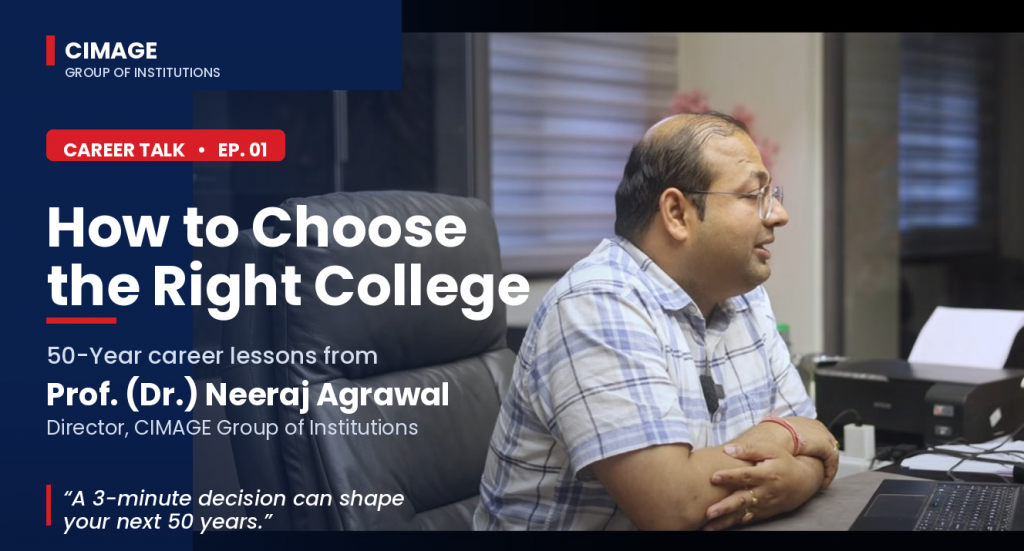
Choosing the right college is one of the most important decisions a student will ever make. During a recent Career Talk session at CIMAGE Group of Institutions, Prof. Dr. Neeraj Agrawal shared a powerful insight that resonated with students and parents alike: “A three-minute decision can impact the next fifty years of your career.
Are you choosing a college for a degree, or are you choosing a college for your future?
Every year, thousands of students spend months preparing for board examinations and entrance tests. Yet when it comes to selecting a college, many make the decision within minutes—based on a friend’s suggestion, a relative’s opinion, social media advertisements, or incomplete information.
According to Dr. Neeraj Agrawal, this is one of the biggest mistakes students can make.
In today’s world of Artificial Intelligence, automation, and rapidly changing industries, college selection is no longer just an academic decision. It is a career decision that can influence opportunities, skills, confidence, professional networks, and employability for decades to come.
Drawing from CIMAGE’s experience of transforming thousands of students from Bihar into successful professionals working in leading organizations across India, Dr. Agrawal shared a roadmap for building a successful and future-ready career.
Here are the key lessons from that insightful discussion.
Choosing the right college is not simply about selecting a campus or earning a degree. Choosing the right college means finding an institution that helps students develop skills, gain industry exposure, and prepare for long-term career success. At CIMAGE Group of Institutions, this philosophy forms the foundation of the learning experience, ensuring students are prepared not only for examinations but also for real-world careers.
Why Choosing the Right College Matters More Than Ever
Choosing the right college is one of the most important decisions a student can make. While a college education may last only three or four years, the impact of choosing the right college can influence career opportunities, professional growth, and success for decades.
The right institution does much more than provide a degree. It creates an environment where students learn to communicate effectively, solve real-world problems, work with modern technologies, and prepare themselves for professional success.
At CIMAGE Group of Institutions, the focus has always been on preparing students not just for examinations, but for careers.
This philosophy has helped students from cities, towns, and rural districts across Bihar secure opportunities in leading companies and pursue higher education at prestigious institutions.
How CIMAGE Identifies Students with Potential, Not Just Marks
Unlike traditional admission systems that focus solely on academic scores, CIMAGE follows a comprehensive admission process designed to understand a student’s aptitude, personality, and career orientation.
The process includes:
Aptitude Assessment
Students are evaluated in:
- English Communication
- Logical Reasoning
- Basic Mathematics
The objective is to identify learning potential rather than simply measuring memorization.
Subjective Evaluation
Students are encouraged to express their thoughts through written responses, helping assess:
- Communication skills
- Creativity
- Vocabulary
- Analytical thinking
Psychometric Assessment
This unique stage helps evaluate:
- Career goals
- Personal interests
- Learning mindset
- Course suitability
Personal Interview
The final interaction helps understand a student’s aspirations, educational commitment, and future vision.
This approach ensures that students entering CIMAGE are prepared to actively participate in a career-focused learning environment.
Empowering Students from Rural Bihar Through Education
One of the most inspiring aspects of the Career Talk was Dr. Agrawal’s emphasis on the transformative power of education.
Many students joining professional colleges come from Hindi-medium schools or rural backgrounds with limited exposure to English communication and technology.
At CIMAGE, these challenges are addressed through structured bridge programs that help students build confidence in:
- English communication
- Computer fundamentals
- Professional etiquette
- Mathematics fundamentals
The objective is simple:
Talent should never be limited by geography.
Over the years, students from districts such as Saharsa, Madhubani, Sitamarhi, Begusarai, Purnea, and many other parts of Bihar have successfully built careers in leading organizations through consistent guidance and skill development.
Why Industry-Oriented Learning Is the Need of the Hour
The traditional model of education focused primarily on classroom lectures and theoretical knowledge.
Today’s employers expect much more.
They seek professionals who can:
- Solve problems
- Communicate effectively
- Adapt to technology
- Work collaboratively
- Apply knowledge practically
To bridge this gap, CIMAGE follows an industry-oriented learning approach inspired by leading management and technical institutions.
Story-Based Learning
Complex concepts are introduced through relatable scenarios before moving into advanced analysis and applications.
Project-Based Education
Students work on practical assignments and real-world projects to develop hands-on experience.
Skill-Focused Training
The emphasis remains on building employable skills rather than simply completing a syllabus.
Preparing Students for the Age of Artificial Intelligence
Artificial Intelligence is transforming every industry.
Recognizing this shift, CIMAGE regularly organizes learning initiatives focused on emerging technologies such as:
- Generative AI
- Agentic AI
- Data Analytics
- Cloud Computing
- DevOps
- Cyber Security
- Digital Transformation
These initiatives help students stay aligned with evolving industry expectations and future career opportunities.
The Three Pillars of Career Success
According to Dr. Neeraj Agrawal, every student should focus on mastering three critical skill areas.
Communication Skills
Strong communication builds confidence and improves employability.
Technical Skills
Knowledge of technology, digital tools, AI, and data-driven systems is increasingly essential.
Management Skills
Leadership, teamwork, decision-making, and problem-solving abilities help students succeed in any profession.
At CIMAGE, all three areas are integrated into the student development journey.
Why Every Student Must Build Their Own Project
One of the most unique aspects highlighted during the discussion was CIMAGE’s emphasis on individual project development.
Rather than relying on group submissions where only a few students actively contribute, students are encouraged to develop their own projects and demonstrate their individual competencies.
This approach helps students:
- Build practical expertise
- Create professional portfolios
- Improve interview performance
- Gain confidence in their abilities
Beyond Placements: Preparing Students for Higher Education
Career success can take many forms.
While many students seek placement opportunities, others aspire to pursue higher education and competitive examinations.
To support diverse career goals, students receive guidance for:
- CAT
- MAT
- Bank PO
- MCA Entrance Examinations
- MBA Programs
- Advanced Professional Certifications
This ensures that students remain prepared for multiple career pathways.
Looking Ahead: Future Opportunities Through Emerging Programs
As industries continue to evolve, educational institutions must evolve alongside them.
The introduction of new-age programs and advanced technology-focused learning opportunities reflects the growing demand for skilled professionals across sectors such as:
- Computer Science
- Artificial Intelligence & Machine Learning
- Electronics & Communication
- Electrical Engineering
- Civil Engineering
The future belongs to students who combine technical expertise with adaptability and continuous learning.
The CIMAGE Philosophy: There Are No Shortcuts to Success
Perhaps the most important lesson from the Career Talk was that no institution can guarantee success without student commitment.
Opportunities are created through:
- Regular attendance
- Active participation
- Skill development
- Project work
- Workshops
- Continuous learning
As Dr. Agrawal emphasized, students who fully engage in the learning process position themselves for long-term career success.
For students and parents, choosing the right college should involve evaluating placement support, industry exposure, faculty expertise, skill development opportunities, industry partnerships, and long-term career prospects. The right institution does not simply provide a degree—it creates an environment where students can grow, learn, and prepare for a successful future.
How Choosing the Right College Can Shape the Next 50 Years of Your Career
Choosing a college is not simply about where you will study for the next three or four years.
It is about choosing the environment that will shape your skills, mindset, confidence, professional network, and career opportunities for decades to come.
At CIMAGE Group of Institutions, the focus has always been on helping students become industry-ready professionals through practical learning, skill development, technological exposure, and career-focused education.
As Prof. Dr. Neeraj Agrawal reminded students during Career Talk:
The decision you make today can influence the next fifty years of your career. Choose wisely.
Frequently Asked Questions (FAQs)
Who is Prof. Dr. Neeraj Agrawal?
Prof. Dr. Neeraj Agrawal is the Director of CIMAGE Group of Institutions and an academic leader known for promoting industry-oriented and skill-based education.
Why is choosing the right college important for career success?
The right college provides practical exposure, skill development, industry connections, placement support, and career guidance that can significantly influence long-term professional growth.
How does CIMAGE help students become industry-ready?
CIMAGE focuses on communication skills, technical training, project-based learning, workshops, internships, emerging technologies, and career-oriented development programs.
Why is choosing the right college important for career success?
Choosing the right college helps students develop industry-relevant skills, gain practical exposure, access placement opportunities, and build a strong foundation for long-term career growth.
How can students choose the right college after Class 12?
Students should evaluate factors such as curriculum, faculty, placement support, industry exposure, skill development programs, and career opportunities before choosing a colleg
Is CIMAGE a good option for students looking for career-focused education?
CIMAGE focuses on industry-oriented learning, skill development, practical exposure, and placement preparation, helping students build successful careers in various sectors.
Can students from rural backgrounds succeed in professional careers?
Yes. With the right guidance, training, and opportunities, students from rural and Hindi-medium backgrounds can build successful careers in leading organizations.
What makes CIMAGE different from traditional colleges?
CIMAGE emphasizes practical learning, individual project development, industry exposure, skill enhancement, and employability-focused education rather than only academic instruction.
Why is choosing the right college important?
Choosing the right college helps students build industry-relevant skills, gain practical exposure, improve employability, and prepare for long-term career success.
Does CIMAGE provide training in Artificial Intelligence and emerging technologies?
Yes. Students are exposed to areas such as Generative AI, Agentic AI, Cloud Computing, Data Analytics, and other industry-relevant technologies through workshops and learning initiatives.
Is BCA a good career option after Class 12?
Yes. BCA remains one of the most popular career-oriented programs for students interested in software development, IT services, AI, data analytics, and technology-driven careers.
Does CIMAGE help students prepare for higher education and competitive exams?
Yes. Students receive guidance and support for CAT, MAT, Bank PO, MCA entrance examinations, MBA admissions, and other career advancement opportunities.
