
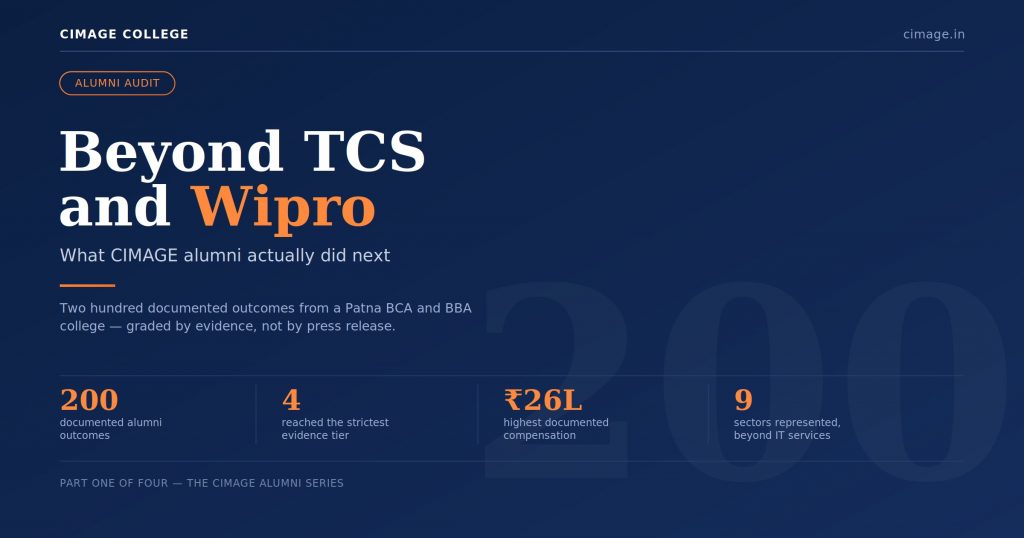
Two hundred documented outcomes from a Patna BCA and BBA college — graded by evidence, not by press release.
Every college in India has a placement page, and every placement page tells the same story: a wall of recruiter logos, a record package, a number with a plus sign after it. The story is usually true and almost always uninformative. It describes the moment a student leaves, which is the least interesting thing you can know about an education.
So we asked a different question about the CIMAGE placement record. Not how many students were placed, but where they are now — five years on, ten years on, fourteen years on. We built a roster of two hundred named alumni outcomes and, more importantly, graded every one of them by how good the underlying evidence actually was. What follows is what survived that grading.
What this audit found
- Two hundred documented alumni outcomes, graded into three evidence tiers — only four reached the strictest tier.
- The recruiter base runs far wider than IT services: banking, Big Four consulting, telecom, FMCG, automobile and one overseas pathway.
- A subset of graduates reached Manager, Technical Lead, Senior Consultant and Product Manager roles seven to twelve years after graduation.
- CIMAGE alumni work at Amazon and Microsoft. Neither company recruits on campus — and the two claims must stay separate.
- The published 13,500+ placement figure needs a stated definition, because students in this record routinely hold several offers each.
- Documented compensation runs from ordinary fresher packages up to ₹26 lakh — but the high end is mid-career pay, not campus pay.
In this article
- Why placement statistics are weak evidence
- The recruiter base, sector by sector
- The distinction that matters most
- The seniority is real, and it is recent
- Four outcomes worth examining individually
- Compensation, stated carefully
- The international thread
- One number that needs defining
- What this means if you are choosing a college in Patna
- What actually impressed us
- Frequently asked questions
Why placement statistics are weak evidence
Placement numbers have a structural problem that has nothing to do with honesty: the institution being measured is also the institution doing the measuring. There is no shared definition of a placement, no external audit, and no mechanism for a parent in Patna to check any of it. Two colleges can publish wildly different numbers from identical underlying results, simply by counting differently.
The three choices that move the number
Three definitional decisions do most of the damage, and almost no institution states which it made:
- Offers or students. A student holding three offers can be counted once or three times. Nothing else changes, but the headline can triple.
- The denominator. Every student on the rolls, or only those who registered for placement? Excluding students who chose higher studies, government exams or the family business can lift a percentage by twenty points.
- Offered or accepted. A job offered and declined is still an offer. Counting it is defensible; not saying you counted it is not.
None of these is dishonest in itself. All of them move the headline substantially. The problem is not that colleges choose — they have to choose — but that the choice is almost never disclosed, which makes the resulting figure uninterpretable rather than merely optimistic.
What this audit does instead
This series starts from named individuals with documented outcomes, grades the evidence behind each one, and publishes the grading alongside the result. Where the evidence is thin, the entry stays in the lowest tier and is described as such. The full method is set out in Part Four, including a published list of everything the research refuses to claim.
The recruiter base, sector by sector
The familiar names are there and they are large. Across the roster, ICICI Bank accounts for the single biggest concentration of documented outcomes, followed by TCS, then Wipro, Cognizant, Airtel, Capgemini, Accenture and Deloitte. That is a banking-and-IT spine, built through repeat recruitment over more than a decade rather than a single exceptional year.
Repeat recruitment matters more than the logo count. A recruiter that returns three years running is making a judgement about the graduates it hired last time. A one-off visit tells you a placement cell made a phone call. Sorting the two hundred entries by sector gives a more useful picture than any logo wall:
| Sector | Organisations appearing in the roster |
|---|---|
| IT services | TCS, Wipro, Cognizant, Infosys, Accenture, Capgemini, Tech Mahindra, HCL, LTIMindtree, Coforge, DXC/Luxoft, Mphasis |
| Banking & financial services | ICICI Bank, HDFC Bank, Axis Bank, Kotak Mahindra Bank, RBL Bank, IndusInd, HSBC, ICICI Lombard, Morningstar, DESRI |
| Consulting & Big Four | Deloitte, EY, EY Global Delivery Services, KPMG, PwC |
| Product & technology | Amazon, Amazon Music, Microsoft, Dell, IBM, Novigo Solutions |
| Telecom & digital | Airtel, Reliance Jio, Vodafone Idea, Paytm |
| Consumer, retail & FMCG | Flipkart, Berger Paints, Godrej, Havells, BigBasket |
| Automobile & manufacturing | Maruti Suzuki, Volkswagen, Mahindra, Force Motors |
| Business services | Genpact, Concentrix, Teleperformance, FirstMeridian, Pyramid IT |
| International | Americana Group (Dubai), CGS Enterprises (Georgia), Xgen Coders Inc. |
A placement brochure would list all of those as equals. They are not equals. A campus drive selecting a hundred students for a support role and a single alumnus reaching a product-management position are different kinds of fact, requiring different kinds of proof, and the rest of this article is about keeping them apart. CIMAGE’s placement record and offer letter archive are the primary sources throughout.
The distinction that matters most
There is a claim colleges make that sounds modest and is in fact enormous: “our alumni work at Microsoft.” It is usually true. It is also routinely allowed to imply something quite different — that Microsoft recruits on campus.
CIMAGE should not blur those two things, so let us separate them cleanly. Saurav Sah, a BCA alumnus of the 2011–14 batch, has built roughly a nine-year career at Amazon and is documented as an Operations Lead for the West region. Ahmad Khan, another BCA alumnus, appears independently on LinkedIn at Amazon Music. Alok Ranjan, BBA 2014–17, reached Microsoft India.
Note — CIMAGE alumni work at Amazon and Microsoft — supported by the evidence. Amazon and Microsoft are CIMAGE campus recruiters — not established, and the two should never appear in the same sentence as though they were one claim.
Read properly, the weaker-sounding claim is the more impressive one. A campus visit by a large employer is something a placement cell can arrange, and arranging it says more about the placement cell than about the education. A graduate of a Patna BCA programme spending nine years inside Amazon and rising to lead a region is something no placement cell can arrange. That is the graduate’s own doing. The college’s contribution was to make the first rung reachable — which is a real contribution, and a more defensible one to claim.
The first job is what a placement cell can give you. The fifth job is what an education gave you.
This distinction is not pedantry. It is the difference between a claim that collapses the moment somebody checks and a claim that survives scrutiny. Institutions that blur it usually do so because the honest version sounds smaller — and then lose the benefit of both when the blur is noticed.
The seniority is real, and it is recent
The most striking thing in the roster is not any single famous logo. It is the accumulation of mid-career and senior titles — the kind that only appear seven to twelve years after graduation, and only if the early career did not stall.
| Alumnus | Programme | Role |
|---|---|---|
| Anup Gupta | BCA | Manager — Intelligent Data Analytics & Advisory, PwC, Bengaluru |
| Priyanka | CIMAGE alumna | Associate Test Manager, Novigo Solutions, Bengaluru |
| Nitin Raj | BCA | Senior Associate — Cloud & Infrastructure, Coforge |
| Prince Kumar | CIMAGE alumnus | Senior Consultant C1, Capgemini, Noida |
| Sushant Ketu | BSc IT | Technical Lead, Coforge, Greater Noida |
| Pratik Kumar | BCA | Senior Consultant — Technology Consulting, EY |
| Raj Priyadarshi | BCA | Consultant, EY Global Delivery Services, Kolkata |
| Atul Kumar | BCA | Associate Product Manager, Morningstar, Gurugram |
| Mohammad Reyan | BCA | Analyst — Cyber Transformation / SIEM, KPMG, Gurugram |
| Binit Verma | BBM | Service Delivery Manager, RBL Bank (Senior Manager grade) |
| Saurav Kumar Jha | CIMAGE alumnus | Senior Associate — Screening Utility Ops, HSBC, Hyderabad |
| Divyanshi | BBA | Senior Deputy Manager, ICICI Bank — digital banking & payment gateways |
| Kundan Kumar | BCA | Senior Associate Consultant, Infosys |
| Abhishek Anand | BCA | Senior Service Delivery Engineer, Dell |
| Rahul Raj | BCA | Software Engineer, Luxoft / DXC, Bengaluru |
| Versha Singh | BSc IT | Analyst, DESRI India |
| Purushottam Kumar | CIMAGE alumnus | Cloud Operations Engineer, BlazeClan, Pune |
| Abhishek Kumar Singh | BCA | Software Developer, FirstMeridian, Kolkata |
| Vinita Shrivastav | BBM | Procurement Practice Associate, Accenture, Gurugram |
| Jagriti Tiwary | CIMAGE alumna | Talent Acquisition Specialist, deployed at LTIMindtree, Pune |
Look at what those roles have in common. Manager. Technical Lead. Senior Consultant. Associate Product Manager. Service Delivery Manager. Senior Deputy Manager. These are not fresher designations, and they are not roles a college can hand anybody. They are what a career looks like once it has been running for the better part of a decade.
Four outcomes worth examining individually
Aggregate tables hide the interesting part. Four of these deserve unpacking, because each represents an exit from the track a Bihar BCA graduate is generally assumed to be stuck on.
Consulting: Manager grade at a Big Four firm
Anup Gupta at PwC is the clearest case of consulting progression in the roster. Intelligent Data Analytics & Advisory is not a delivery function — it is client-facing advisory work, and reaching Manager grade in it means carrying responsibility for outcomes rather than tickets. It is the single most senior title in the record.
The reason this is hard is structural. Big Four firms recruit their consulting intake heavily from a narrow set of institutions, and lateral entry from IT services generally lands people in delivery roles rather than advisory ones. Crossing from one to the other is a deliberate move that takes years.
Cybersecurity: a specialism you cannot fake
Mohammad Reyan’s move into cyber transformation and SIEM work at KPMG matters for a different reason. Security engineering demands sustained technical investment long after graduation, usually in the graduate’s own time and at the graduate’s own expense. Certifications are examined, tooling changes constantly, and the work is audited. Nobody arrives there by drifting.
Cloud and infrastructure: the highest-demand exit
Nitin Raj and Sushant Ketu at Coforge — Senior Associate for Cloud & Infrastructure, and Technical Lead — represent the cloud-infrastructure route out of generic services work. This is currently among the strongest demand areas in Indian IT, and it rewards certification and hands-on depth rather than pedigree, which is precisely why it is reachable from a tier-two college.
Purushottam Kumar’s Cloud Operations Engineer role at BlazeClan in Pune is the same pattern at an earlier stage, which is useful: it shows the route is not a single freak occurrence but something more than one graduate has found.
Product management: the rarest move of all
Atul Kumar’s Associate Product Manager role at Morningstar is the most unusual of the four. Product management is a move out of execution and into judgement about what gets built and why. It is a notoriously difficult transition from a services background — most people who attempt it do not complete it — and it is rare enough from any Indian tier-two college that it deserves to be noted rather than buried in a list.
Compensation, stated carefully
CIMAGE publishes its offer letters, so the figures attached to these roles are already in the public domain. They are worth reporting, with one caveat stated first: several of these represent alumni compensation reached years after graduation, not campus packages. Presenting them as fresher salaries would be dishonest — and would also, oddly, undersell them.
| Role | Organisation | Reported CTC |
|---|---|---|
| Manager — Intelligent Data Analytics & Advisory | PwC | ₹26.00 LPA |
| Associate Test Manager | Novigo Solutions | ₹24.00 LPA |
| Senior Associate — Cloud & Infrastructure | Coforge | ₹17.00 LPA |
| Senior Consultant C1 | Capgemini | ₹16.00 LPA |
| Technical Lead | Coforge | ₹15.00 LPA |
| Senior Consultant — Technology Consulting | EY | ₹15.00 LPA |
| Consultant | EY Global Delivery Services | ₹14.36 LPA |
| Software Engineer | Luxoft / DXC | ₹14.00 LPA |
| Consultant B2 | Capgemini | ₹14.00 LPA |
| Associate Product Manager | Morningstar | ₹12.66 LPA |
| Analyst | DESRI India | ₹12.50 LPA |
| Senior Software Engineer | Pyramid IT Consulting | ₹12.00 LPA |
| Consultant B2 | Capgemini | ₹11.50 LPA |
| Consultant B2 | Capgemini | ₹9.00 LPA |
| Service Delivery Manager | RBL Bank | ₹10.00 LPA |
| Finance Executive | Reelotek | ₹9.66 LPA |
A ₹3–4 lakh campus package and a ₹26 lakh mid-career package are not competing claims, and there is no need to choose between them. They are the two ends of the same graph. The graph is the point — and an institution that only ever publishes the left-hand end is telling an incomplete story about its own graduates.
Note — Read any “highest package” figure with care, here and everywhere. A maximum describes exactly one person. It is not a forecast, it is not typical, and on its own it tells a prospective student almost nothing about what to expect.
The international thread
Here the evidence needs separating again, because “our alumni work abroad” is the vaguest sentence in Indian college marketing. What can actually be shown is narrower and considerably better.
A documented overseas placement pathway
The cleanest case is a genuine overseas recruitment route. In a single 2024 recruitment cycle recording 263 selections, seven students went to Americana Group in Dubai. That same cycle produced 132 ICICI Bank selections, 24 at TCS, 17 at Accenture and 7 at Axis Bank. Aargya Soni, a BBA alumnus of the 2021–24 batch, went on to work as a Data Analyst at Americana.
Two individual international trajectories
Rahul Abhishek, CIMAGE 2016–19, founded Xgen Coders Inc. and has professional exposure spanning the United States, South Africa and Malaysia, alongside project-management and business-analysis certifications accumulated after graduation. Md Mahtab Alam, from the same cohort, has built an industrial career based in Rustavi, Georgia.
Neither is a placement statistic. Both are people who used a Patna undergraduate degree as a starting point rather than a ceiling — which is the more valuable thing to demonstrate, and the harder thing to manufacture.
Note — What cannot be claimed: a count. We are not in a position to say “X CIMAGE alumni work in the USA, Y in Dubai, Z in Canada.” LinkedIn does not publicly expose location data at that resolution, and inventing the number would poison every real figure beside it.
One number that needs defining
A recurring pattern in the record is that strong students collect several offers each. Sandhya Kumari held Wipro and TCS offers. Sanket Kumar held Accenture, TCS and an Aditya Birla/UltraTech offer. Sonali Kumari held ICICI Bank and Accenture. Ujjawal Kumar held TCS Ignite and Accenture. Aargya Soni is reported to have accumulated twenty-six.
That is a good problem, but it is still a problem. If a student holding three offers is counted three times, then a headline like “13,500+ placements” is counting offers rather than people — and those are very different denominators. This is not an accusation. It is a definition that should simply be stated.
An institution confident in its record loses nothing by saying precisely what it counts, and gains the one thing marketing numbers never have: the ability to be checked. Publishing “13,500 offers across N students since 2005” would be a stronger claim than “13,500+”, not a weaker one, because a reader could do something with it.
What this means if you are choosing a college in Patna
Most families comparing colleges are shown placement percentages and highest packages, because that is what gets put in front of them. Both are close to useless as decision tools. The percentage depends on undisclosed definitions, and the highest package describes one student who is not going to be your child.
Four questions produce far more signal, and any institution should be able to answer them:
- What is the median package, not the highest? The median describes a typical outcome. The maximum describes an outlier and predicts nothing about the middle of the distribution.
- How many distinct students were placed, as against how many offers were made? If an institution cannot separate these, its headline number cannot be interpreted at all.
- Which recruiters have returned three years running? One-off visits inflate a logo wall. Repeat recruitment is evidence of a relationship, and of graduates who performed well enough for the employer to come back.
- Where are the 2014 and 2015 graduates now? This is the question almost no prospectus answers, and it is the only one that measures the education rather than the placement cell.
On the fourth question, this series is an attempt at an answer. The programme pages — BCA, BBA, B.Sc. IT, MCA and MBA — describe what is taught. This describes what happened afterwards, which is a different and more demanding kind of claim.
What actually impressed us
Not the volume. A well-drilled institution can prepare a large cohort to clear a national assessment, and clearing one is a smaller achievement than it appears from outside.
The unusual signal is the shape of the careers behind the volume. A recognisable path runs through this roster: a BCA, BBA or BSc IT degree, then a first job at TCS, Wipro, Cognizant, Accenture or ICICI Bank, then several years of switching and upskilling, and then arrival somewhere materially better — consulting, cloud infrastructure, cybersecurity, product management, senior banking, or a product company.
Fourteen years of graduating cohorts have now produced enough of these to see a pattern rather than an anecdote. That is the claim worth defending, and it is a more modest one than most placement pages make. It is also considerably harder to fake.
Part Two tests it against independent employment data rather than institutional records, and Part Three follows the 2012–2019 cohorts to see whether the early advantage survives a decade.
Frequently asked questions
Do CIMAGE alumni work at Amazon and Microsoft?
Yes. Saurav Sah, a BCA alumnus of the 2011–14 batch, is documented as an Operations Lead at Amazon after roughly nine years there. Ahmad Khan appears independently on LinkedIn at Amazon Music, and Alok Ranjan, BBA 2014–17, reached Microsoft India. However, neither Amazon nor Microsoft is a CIMAGE campus recruiter — these are alumni who reached those companies later in their careers, which is a different and separate claim.
Which companies recruit from CIMAGE Patna?
The largest documented recruiters across the roster are ICICI Bank, TCS, Wipro, Cognizant, Airtel, Capgemini, Accenture and Deloitte. The wider record also includes Infosys, HCL, Tech Mahindra, LTIMindtree, Coforge, Axis Bank, HDFC Bank, Kotak Mahindra Bank, Genpact, Flipkart, Maruti Suzuki and Reliance Jio, plus an overseas pathway to Americana Group in Dubai.
What is the highest package from CIMAGE?
The highest figure in the published offer-letter archive is ₹26 lakh per annum, for a Manager role in Intelligent Data Analytics & Advisory at PwC. It is important to read this correctly: it is alumni compensation reached years after graduation, not a campus placement package for a fresher. Any highest-package figure describes exactly one person and should never be read as typical.
Is CIMAGE good for BCA placements?
On the evidence of alumni employment rather than institutional claims, CIMAGE shows an unusually dense concentration of graduates at large IT and banking employers — roughly 15.4% of its indexed LinkedIn alumni are at TCS or Wipro alone, several times the rate found at comparable institutions in the city. The full analysis is set out in Part Two of this series.
Do CIMAGE alumni work abroad?
There is documented evidence of overseas outcomes: seven students placed with Americana Group in Dubai in a single 2024 cycle, an alumnus working in Rustavi, Georgia, and another with professional exposure across the United States, South Africa and Malaysia. What cannot honestly be given is a count of alumni working in any particular country, because LinkedIn does not publicly expose location data at that resolution.
What does the 13,500+ placement figure actually count?
This is precisely the question the audit raises. Students in CIMAGE’s own record frequently hold multiple offers — one is reported to have collected twenty-six — so a figure counting offers and a figure counting distinct students would differ substantially. Until the counting basis is stated publicly, the number cannot be interpreted with confidence.
How reliable is this alumni research?
Every one of the two hundred entries is graded by evidence quality. Only four reached the strictest tier, which requires independent corroboration from a source with no interest in the outcome. Thirty-two rest on offer or appointment letters, and the remaining 164 are documented placements with no claim made about current seniority. The grading and its weaknesses are published in Part Four.
The rest of this series
- The Alumni Footprint: What Independent Data Says About CIMAGE — Measured by where graduates say they work — not by what any institution says it achieved.
- Fourteen Years On: Where the 2012–2019 Graduates Are Now — Does an early placement advantage survive a decade? A cohort study of what happened after graduation.
- How We Counted: The Method Behind the Alumni Audit — Evidence tiers, known weaknesses, and a published list of the things this research refuses to claim.
Primary sources
Figures in this series are drawn from the following, read at the time of writing. LinkedIn aggregates change continuously.
